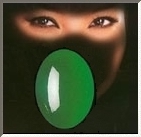
Jadeite
800 . 699 . JADE
Jadeite

Define Jade

Jade refers collectively to two different minerals ---
Jadeite and Nephrite.
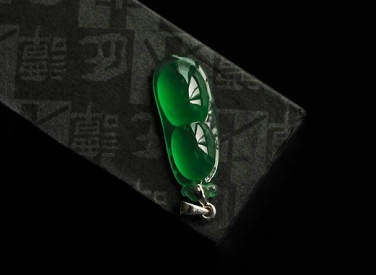
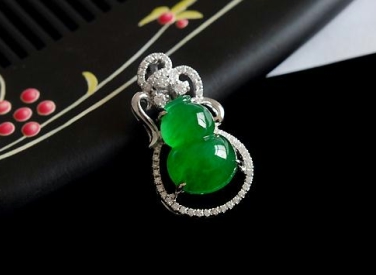
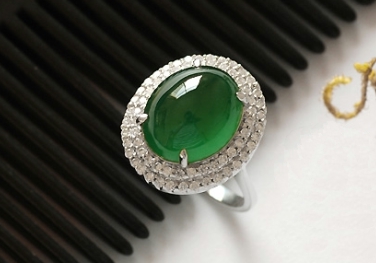
Most Jade of gem value is Jadeite Burmese Jade.
Most valuable is the Imperial Jade, an emerald
green transparent jadeite from Burma
.

In academic terms -- Jadeite and Nephrite have

different physical and chemical characteristics:


Nephrite

Jadeite

Chemical composition

Ca2(Mg, Fe)5Si6O22(OH)

NaAISi2O6

Mineral composition

Amphibole Group

Pyroxene Group

Crystalline structure

fibrous

micro-granular

Hardness

6-6.5

6.5-7

Specific gravity

2.9-3.1

about 3.33

Refractive index

1.62

1.65-1.66

Polished surfaces

Smooth with a waxy sheen

Hard and lustrous

Color

Evenly distributed; translucent
white, dark green, black

Spotty or clustered distribution; white, grey, green

In China, where jade has been treasured the most, there was only
nephrite before the 18th century. The highly treasured pieces from that
time are creamy white in color and uniformly translucent.
Since the mid-18th century, jadeite has been imported from Burma
(now Myanmar), and has become the most popular form of jade
in China.  Besides in Burma,  jadeite is also found in Japan, part of the
former Soviet Union, Central America, and California. The actual color
and the texture of the jadeite piece derives from the metallic element(s)
it contains and the way the piece was formed geologically.
Green jadeite, known as fei tsui in Chinese, seems to be used almost
exclusively in jewelry-setting, and is the most popular type of jadeite.

Jade quality analysis --"Three T's"

Tone     describes the specific quality of a color grade. The Finest colors
are "penetrating" and vivid from a distance. They should be pure. evenly
distributed and free of brown or gray tones.
Translucency    ranges from near transparent to opaque. The Highest
quality has a body appearance that resembles honey.
Texture    ranges from fine to coarse. The highest quality is clear and
free of irregularities.

Jadeite Characteristics

Most Desirable
1. Intense Color.
2. Even Color.
3. Honey-like 
    Transparency.
4. Translucency.
5. Watery Luster.
6. Smooth Finish.
7. Even Texture.
8. Pure.
9. Vivid root-like
    Structure.

Less Desirable
1. Dull Color.
2. Uneven Color.
3. Opacity.
4. Cloudy Appearance.
5. Dehydrated
    Appearance.
6.Surface Cracks.
7. Blotch Texture.
8. Mottled.
9. Dull root-like
    Structure.

Green Jadeite Color Grading Terminology

U.S.A 
1. Imperial/Emerald
2. Glassy
3. Apple Green
4. Spinach
5. Moss-in-snow
6. Apple Green
7.  

ORIENT
1. Old Mine
2. Canary
3. New Mine
4. Oily
5. Pea Green
6. Flower Green
7. Melon.

Define Fine Green Jade

Green jadeite is also known as fei tsui. The criteria we employ for its
appreciation are: color, clarity, cutting, flaws and transparency. Because of the
nature of jadeite, unless the piece in question is small, quality is seldom uniform
throughout the piece. Therefore, we have to assess the quality of salient parts
of the piece and then look at the relationship of those parts to the whole piece.

Color:

Color is of paramount importance. We examine the green
Burmese Jadeite according to its:

Varying degrees of color intensity from the left, the most saturated to
the right the less.

Purity:

The most desirable is emerald green; in descending order of
desirability are green tinted with yellow, blue and gray.

Intensity:

The more saturated the green the better. However, an overdone
intensity is of only middling quality.

Vividness:

The color should be vibrant and lively. The presence of gray and
black makes the green dull without altering its tint.

Evenness:

The more even the color, the more desirable the jade.

Vivid against dull color of Jadeite.

Transparency:

The range is from opaque to transparent, with the latter being the
rarest and therefore most sought after.

Transparency of Jadeite Jade.

Clarity:

Jadeite, like other minerals,
usually contains inclusions in the
form of veins and spots. In
general, white inclusions are less
distracting than black ones and,
of course, the less visible the
inclusion the better.

Black inclusions affect the value of jade.     >>>         

Cutting:

Jadeite is usually worked into two categories: plain polished
shapes such as cabochon and carved designs.
Plain polished shapes require higher grade material without flaws.
Ratings are made on their proportion and symmetry. For example,
a well-cut cabochon should be neither too thick nor too thin in
relation to the area of its top surface. It's "bulge" should be
centered, prominent but not exaggerated.

Plain polished shapes require higher grade material without flaws.
Ratings are made on their proportion and symmetry. For example,
a well-cut cabochon should be neither too thick nor too thin in
relation to the area of its top surface. It's "bulge" should be
centered, prominent but not exaggerated.

Carved designs are often used to eliminate or minimize the effect
of flaws and cracks. They are assessed on their aesthetics and the
workmanship of the details. .

The artistic carving produced on this piece of jade increases its value.  

Flaws:

Tiny flaw lines, though certainly a value-detractor, need not be objectionable.
A flaw that cuts through from one side to the other can be a serious fault.
Use a
strong flashlight to examine cracks and flaws.

One can readily see that the criteria do not form a system of valuation. They
are the bases for the "aesthetics of green Jadeite", and as such they facilitate
an educated assessment of green jade. It is difficult to see how one could
come up with an empirical valuation system. Perhaps that is what make
jade so fascinating! .

Attributes of Jade

A long time ago, there was a man who had a miraculous experience
which he believed was caused by a piece of jade in his possession.
When he died, he passed his jade on to his son. The jade was then
passed from one generation to the next with the belief that 'jade keeps
you from evil and disasters'. This is part of jade's deep attraction to
the Chinese, aside from its intrinsic beauty, also a symbol of protection.

The nobility and uniqueness characteristics of jade attract people,
some keep it as personal possession like ornaments and jewelry,
while others treat it as a symbol. The various colors of green, red,
yellow, lavender, black and white, accompanied with quality
craftsmanship provides a wide range of variety to jade lovers.

Jadeite jade is closely bound with the Chinese and Chinese culture
but it does not originate from China. At the present time, Burma
(Myanmar) is still the only place in the world that produces the highest
quality of 'jadeite'. The value of jadeite depends on its degree of
transparency and color. If you are interested in experiencing
something unique, do not hesitate to make a purchase of jadeite.

Manufacturer, Importer and Wholesaler of Fine Jewelry

 : : Home : : About Jade : : Jade Jewelry : : Gem & Gold : : Contact Us : : Information : :

 Copyright©1997 - 2007 Mary’s Jewelry, Inc. All rights reserved.